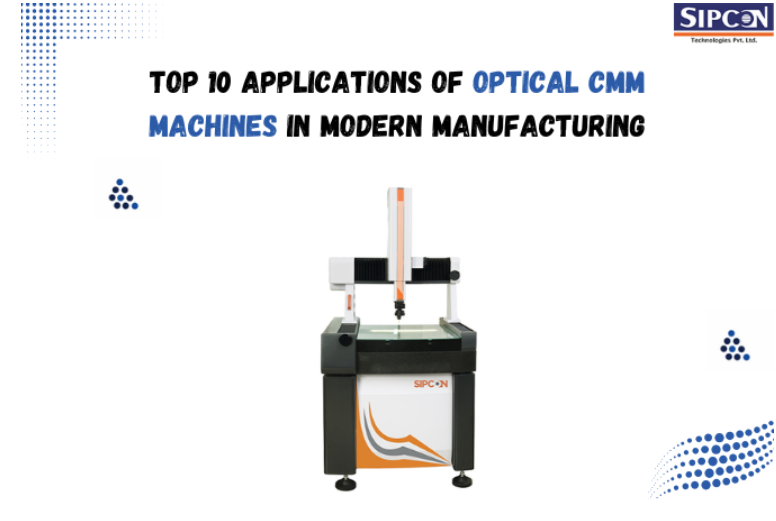
In order to comply with Global Quality Standards, today’s manufacturers need extreme precision, extreme speed, and extreme consistency. Today, components are shrinking and are complex in design; therefore, the old system of using a contact-based measurement system often does not provide the required accuracy for measuring components. As such, there has been a significant shift to using Optical CMM machines within both the Indian and worldwide manufacturing sectors.
By utilizing high-resolution optics along with the most up-to-date software, Optical CMM machines offer manufacturers the ability to perform inspection in an ultra-fast, non-contact manner with a high degree of accuracy. Therefore, both in India and globally, manufacturers are using Optical CMM machines to improve quality control and dimensional verification.
Below are the top 10 applications of Optical CMM machines in modern manufacturing.
-
Precision Dimensional Inspection
One of the primary applications of an Optical CMM machine is high-accuracy dimensional inspection. It measures lengths, diameters, angles, and geometric tolerances with micron-level precision. Compared to conventional gauges, an optical CMM Machine ensures repeatable and reliable results, making it ideal for tight-tolerance components.
-
Inspection of Complex and Intricate Components
Modern components often feature complex geometries, fine edges, and delicate surfaces. Optical CMM machines allow non-contact measurement, eliminating the risk of deformation or surface damage. This makes them especially useful for inspecting intricate profiles that are difficult to measure using tactile probes.
-
Quality Control in Automotive Manufacturing
In the automotive industry, even minor dimensional errors can affect performance and safety. Optical CMM machines are widely used to inspect engine components, transmission parts, and precision assemblies. Their speed and accuracy help manufacturers maintain consistent quality while meeting strict industry standards.
-
Aerospace Component Validation
Aerospace manufacturing requires extremely high accuracy and traceability. Optical CMM machines are used to verify critical dimensions of lightweight and complex aerospace components. Their ability to capture detailed measurement data supports compliance with international aerospace quality norms.
-
Electronics and Micro-Component Inspection
With the miniaturization of electronic devices, component sizes have become increasingly small. Optical CMM machines excel in inspecting micro-components, PCBs, connectors, and semiconductor parts. The non-contact measurement approach ensures accurate inspection without damaging sensitive components.
-
Tool and Die Manufacturing
Tool rooms rely heavily on accurate measurements to produce high-quality dies, molds, and cutting tools. An Optical CMM machine helps manufacturers inspect tool profiles, cavity dimensions, and surface features. This ensures tools perform consistently and reduces rework during production.
-
First Article Inspection (FAI)
First Article Inspection is a critical step in validating new designs and manufacturing processes. Optical CMM machines provide fast and comprehensive measurement reports, helping manufacturers verify that the first produced part meets all design specifications before mass production begins.
-
Reverse Engineering Applications
Optical CMM machines are widely used in reverse engineering to capture precise measurements of existing components. This data can be converted into CAD models for redesign, modification, or reproduction. Industries use this application to improve legacy parts or develop upgraded versions.
-
In-Process Inspection and Process Control
Integrating Optical CMM machines into the production workflow enables in-process inspection. Manufacturers can detect deviations early, adjust machining parameters, and prevent large-scale defects. This improves productivity, reduces scrap rates, and enhances overall process stability.
-
Documentation and Compliance Reporting
Modern manufacturing emphasizes data-driven quality assurance. Optical CMM machines generate detailed inspection reports with images, measurements, and tolerances. These reports support audits, certifications, and compliance with ISO and other international standards.
Role of Optical CMM Machines in Industry 4.0
Optical CMM machines align perfectly with Industry 4.0 initiatives. Advanced software integration allows automated measurement routines, real-time data analysis, and digital traceability. By connecting inspection data with manufacturing systems, companies can achieve smarter and more efficient quality control processes.
About Sipcon Instrument
Sipcon Instrument is a reliable provider of advanced dimensional measurement solutions, offering high-performance Optical CMM machines designed for modern manufacturing environments. Sipcon’s systems are known for their accuracy, robust construction, and user-friendly software. Serving industries such as automotive, aerospace, electronics, and tooling, Sipcon Instruments helps manufacturers achieve superior quality control, improved productivity, and compliance with global standards.
Conclusion
The Optical CMM machine has become an essential asset in modern manufacturing due to its speed, accuracy, and non-contact measurement capabilities. From automotive and aerospace to electronics and toolmaking, the applications of Optical CMM and CMM Machines continue to expand. With trusted solutions from Sipcon Instruments, manufacturers can enhance inspection efficiency, reduce errors, and confidently meet the demands of today’s precision-driven industries.